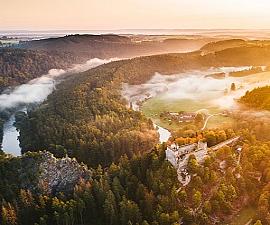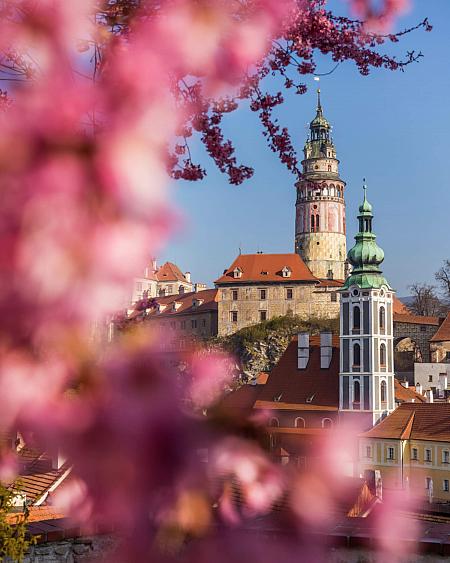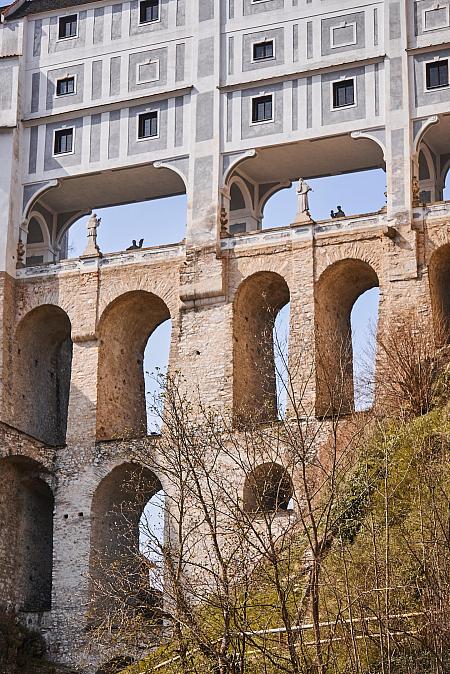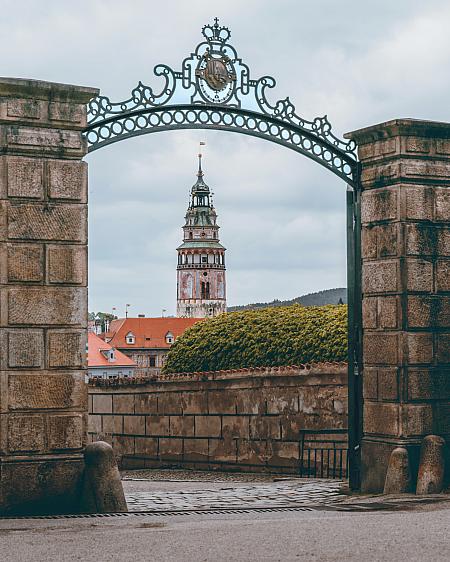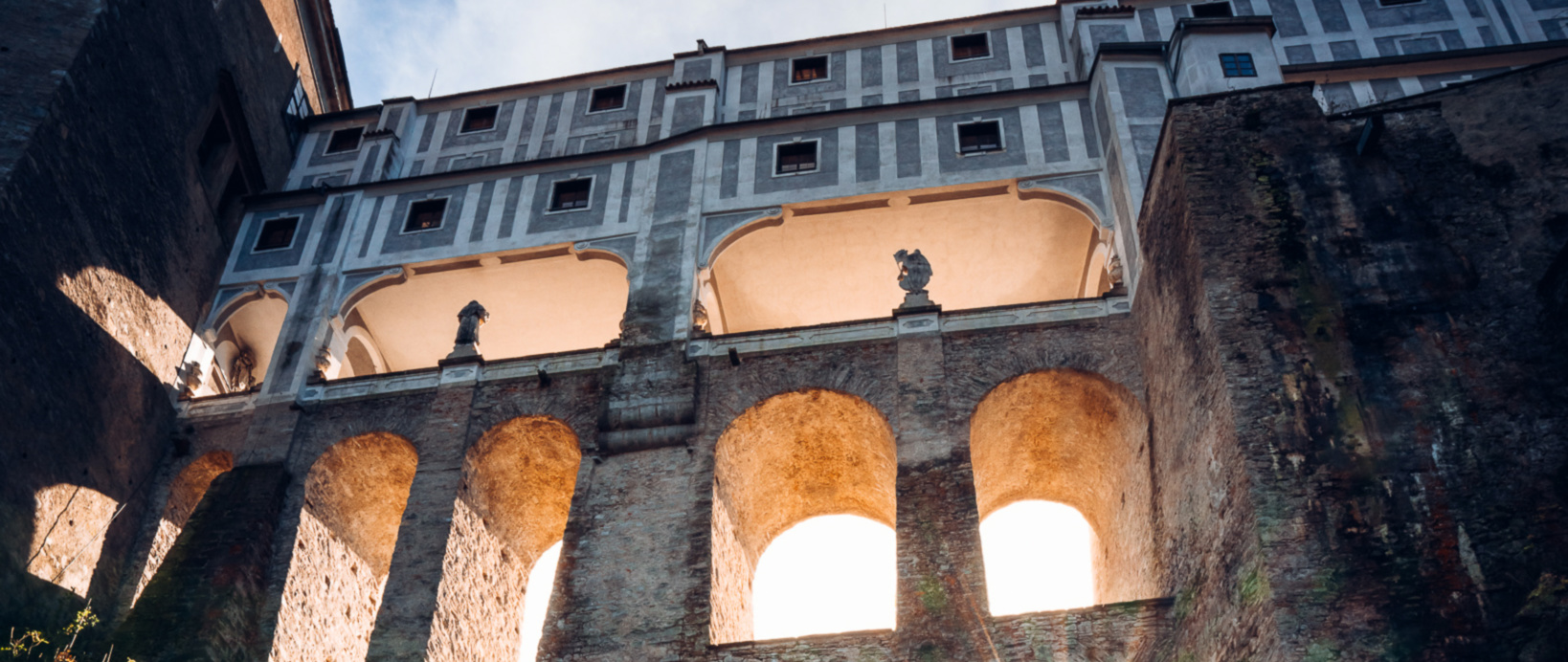
One of the oldest castles in South Bohemia was built by the Family of Vítek around the mid 13th century. The medieval disposition of the castle consisted of the Lower and Upper Castle.

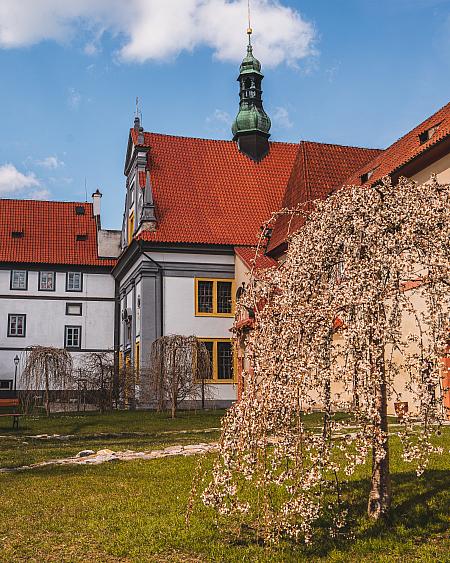
Originally royal castle from 14th century which was damaged by Jindřich of Rosenberg in 1395. In 1495 Peter IV. of Rosenberg invited there friary of St. Frank of Pauly to establish there paulanic monastery. Monastery with single-aisle church of St. Andrew never was finished and about 1530 wholly abandoned.

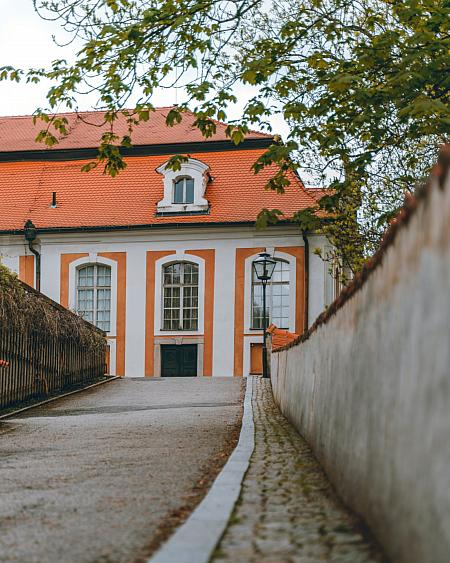
Červený Dvůr Castle - Rococo chateau, surrounded by English gardens - presently the Chateau houses a psychiatric rehabilitative center

Today the fortress no longer exists. It was situated on the place of today's residential building from 18th century and its adjacent yard. The cellars underneath the residential building are the only remains of that fortress.
Church of St. Bartholemew founded before 1277, reconstructed in late gothic style around 1530, and again from 1649-52 and in 1735. The tower was raised or newly built in neogothic style in 1870.
Church of St. Bartholemew - originally the gothic chapel of St. Kateřina founded in the early 14th century.
Church of St. Jakub Větší - originally from the mid 13th century, damaged in 1423, expanded in 1663, completely romanized from 1872 to 1874.

First mention about the church of St. Jiří is from 1359, in 1735 Gothic church was rebuilt and modified in Baroque style. In 1857 was built large vicarage next to the church. School was finished in 1858.
Church of St. Kateřina - originally early gothic, founded in 13th century, completely rebuilt at the turn of the 15th to 16th century.
Church of St. Markéta - first mention in 1374. Originally Gothic structure from the late 13th century, reconstructed in 1694 - 1696 and in 1708.

Church of St. Martin in Polná na Šumavě - original structure from the end of the 13th century. The presbytary, nave, and tower come from this time. The northern side chapel, used as a sacristy, came about during repairs from 1488, when the church was finished in late Gothic style. The church underwent a Renaissance reconstruction in 1653, when the tower was added.

Early Gothic church of St. Mary Magdalena was gothically rebuilt in 1483-1491 and the church tower was modified in 1818.
Originally a Gothic church is the first-cited in 1339 Probably it is haunted, as one of the bells The year 1313th.

First mention is from 1271. Late Gothic structure from late 1400's on older foundations.
Church of St. Simon and Jude, originally of the Holy Mary Magdalena, established around 1340; baroque reconstruction from 1697 - 1704 by G. Caneval. Interior furnishings from 19th century.

Church of St. Vavřinec - Gothic building from the 14th century. Later reconstructed, then regothicized in 1870.

Church of the Archangel Michael - the oldest original part is a Romanic sacristy, where the original vaults were replaced by a new one, and a Gothic presbytary was added in the 14th century. On the site of the destroyed Častolár church from 1557 a new three-knaved church was built in pseudogothic style in 1887.
First mention from 1259, main altar from 1770. Originally Gothic with preserved presbytary and tower walls. Remaining parts built in 1909 by František Schiffhaler.

Cetviny - gothic church of the birth of the Virgin Mary, first mentioned in 1384.

Church of the Holy Mary Magdalena in late gothic style, built from 1487-1507 on the site of an older church. Significant example of Rosenberg late Gothic.

Church of the Immaculate Conception of the Virgin Mary erected 1799-1800 on the site of a former wooden chapel; 1901-1904 modified in new romanesque, tower added.

Dívčí Kámen castle is one of the castles in Bohemia of which the foundation charter was preserved. Today Dívčí Kámen castle with its 210 metres of length and 45 metres of width is one of the largest castle ruins in Bohemia.

Benešov nad Černou was founded in the second half of 13th century by Beneš of Michalovice as a settlement nearby the stronghold.

The fortified settlement of Chlum founded in the 13th century was reconstructed several times during its existence. Those reconstruction led to the fact that the settlement was changed into the farm yard in the 17th century.

The buildings of the fortified settlement are a remarkably valuable example of the Renaissance style of the 16th and the 17th centuries.

Only the torso of the sizeable residential tower was preserved. The tower had a square plan and the length of the sides was 9 metres.

Southeast house number 102 located the remains of "old" cemetery. From the data indicate that the cemetery was established before the year 1480 Were buried here, and all the Jews in Linz until 1863 until the establishment of a Jewish cemetery in Linz.

A building resembling a grange was built on the place of the former fortress.

From the time the castle was established by Vítek z Krumlova (1220 - 1272) in the 13th century, it performed the function of a fortress and an administrative centre of the estates that were part of the growing dominion of the members of the Witigonen family. Their estates were spread on the both sides of today's border between the Czech Republic and Austria.

The little three-wing Baroque castle with the central projection of a wall and four bays on the corbels in the front east side. The Baroque church of Saint Jan Nepomucký is joined to the south wing of the little castle.

Dean church of St. Bortholemew - originally early Gothic, founded in 1259, modified in the 16th century, reconstructed in the 17th century.

Parish church of St. Jiljí - originally founded in 1279, today's building from around 1400. The main period of the building took place in the second half of the 15th century (finished in 1507). One of the best examples of South Bohemian late gothic.

The two-floor prismatic tower in the middle of the decaying yard was preserved until today from the original village and the medieval fortress.

Pilgrimage church of the Virgin Mary - the original church structure is from the late 13th century. The church was destroyed during the Hussite wars in 1422 and 1469, when the militia destroyed a school as well. Today's church was built in late Gothic style from 1471 to 1488. In 1670 the physician Ondřej Volkshofer from Krumlov commissioned an altar to be built.

Baroque sculpture with the heads of angels, images of Christ and Saint Florian´s, Saint Sebastian and Saint Jan Nepomucký´s Sculpture. It is situated on the common. It was built in the second half of 18th century after the plague epidemic.

Slavkov Fortress is one of a few buildings where the original connections of individual elements of a manor were preserved.

Small castle of Louzek is located as a river tear on a wide spit of the fiercely flowing Malše river.

The small castle of Pořešín is a very interesting rarity of the South Bohemian castle architecture of 14th century.

Originally it has been since 1385 a church of hermits from the Pavlans order, founded by Jan and Petr of Rožmberk.

St. Jan Nepomucký´s Statue created in 1726 is located on a three-sided column with reliefs of St. Dominik, St. Leonard, and St. Václav, and statues of St. Donát, St. Florián, and St. Roch.

St. Michael archangel church in Horní Dvořiště is first mentioned in year 1252. It had been founded by Vok of Rožmberk and it has been presented as a parochial church till 1384.

The first stone for chapel was laid down on 19. June 1550. Its founder Jan Častolar dedicated it to St. Voršila, patroness of his daughter.

The first and decisive impulse to build the Stations of the Cross in Frymburk parish gave landowner from Lipno Adalbert Donauer, who at the beginning of ninetieths of 19th century paid six hundred of golds „for granitiform Stations of the Cross“. Chapel was solemnly consecrated on 13. October 1898.

Svatý Kámen Pilgrimage Church - church of the White Virgin Mary resting on a stone - originally a baroque monastery with church and chapel from 1653.

The locality of Studenec near Rožmberk nad Vltavou is called after a well with miraculous water. There was a supported document issued in 1679 proving that it is allowed to celebrate masses in the newly built chapel. The chapel was given the name of St. Anna.

The Vltava Basin situated on the mild knoll is dominated by the late Gothic church. It is probably one of the oldest sacred buildings in South Bohemia.
Originally known as the Church of St. Markéta. In 1339 it was mentioned as the branch of the Rožmberk Parish Church. Nikolaus of Malšín was a rector. The sacristy of our days used to be a chapel consisting of two square fields dating from the second half of the 13th century.

Only the ruins of the castle's fortification, fragments of the semicylindrical bastion and vigorous cylindrical tower situated on a narrow rocky spit above the Malše river were preserved to the present day.

Vicarage church of St. Peter and Paul - first mention in 1257. After a blaze in 1507 rebuilt in late Gothic style. The church is furnished in pseudogothic.

The monastery was founded by Wok von Rosenberg in 1259. He called the Cistercians from Wilhering in Austria to there. On a wish of the founder the monastery became the monastery of the family. Together ten generations of the family were buried there.

The former abbey in Zlatá Koruna is the best preserved Cistercian monastery in Bohemia. The area of the monastery was in 1995 announced as the national cultural treasure.

The Preotected area of Žofín Primaeval Forest ranks among the highest possible protection category - National Park. It is situated in the middle part of the Novohradské Mountains.
|
|
This project was cofounded by the South Bohemian Region |